
AI vs BI: Why the Comparison Misses the Point
5/4/20262 min read
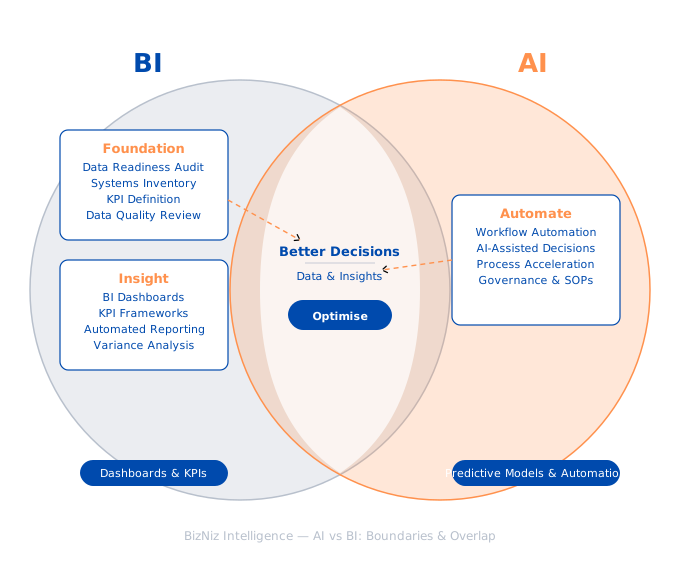
Every week, a growth-stage SME somewhere makes the same mistake. They have messy reporting, manual processes, and a leadership team making decisions on gut feel and outdated exports. So they invest in AI automation to fix it.
Six months later, the automation is live. And the decisions it makes are no better than before.
The data was never the problem they solved for.
This is what happens when AI and BI get treated as competing priorities rather than sequential ones. Budget goes to one or the other. Vendors pitch their tool as the answer to both. And businesses skip a foundational step that determines whether any of it works.
What BI Actually Does
Business Intelligence answers the questions your business has already lived through.
What happened last quarter? Why did margin compress in that product line? Which customer segment is driving churn? BI takes historical and operational data and makes it visible, structured, and comparable. Done well, it gives leadership a single trusted view of performance rather than a spreadsheet three people maintain differently.
The output is clarity. Dashboards, KPI frameworks, variance reporting, drill-down diagnostics. The value is that decisions stop being made on instinct.
What AI Actually Does
AI answers the questions your business has not faced yet.
What is likely to happen next month? Which orders are at risk of delay? Where should effort be redirected before a problem surfaces? AI works forward, using patterns in data to generate predictions, flag anomalies, and automate responses to defined conditions.
The output is anticipation and efficiency. Predictive models, intelligent routing, automated workflows. The value is that the business stops reacting and starts operating ahead of the curve.
Where They Overlap and Why That Matters
The overlap between AI and BI is not incidental. It is where the real leverage sits.
Data and insights generated by your BI layer become the input your AI layer depends on. You cannot build a reliable predictive model on top of fragmented, inconsistent, or poorly defined data. And you cannot govern an automated workflow without the visibility that good reporting provides.
This is why businesses that skip straight to AI automation so frequently stall. The automation may be technically functional, but it is only as good as the data underneath it. Without a clean, governed data foundation, AI amplifies noise as readily as it amplifies signal.
The Practical Implication for SMEs
If your reporting is still manual, your data is scattered across systems, or your leadership team lacks a consistent view of performance, automation is not your next step. Getting your data house in order is.
The work involved is not glamorous. It means auditing what you have, resolving inconsistencies, defining your KPIs properly, and building reporting your team can actually trust. But businesses that do this work first find that AI becomes a genuine multiplier rather than an expensive experiment.
Predictions are grounded in reliable data. Automations operate within defined, auditable boundaries. Decisions get made faster and with greater confidence.
The question is never AI or BI. The question is whether your data is ready to support both, and in what sequence.
BizNiz Intelligence
Contact Details
info@biznizintelligence.com
0420 840 409
ABN: 71 395 842 284
© 2024. All rights reserved.